Mostrando entradas con la etiqueta Audiorama. Mostrar todas las entradas
Mostrando entradas con la etiqueta Audiorama. Mostrar todas las entradas
martes, 10 de diciembre de 2013


martes, 11 de septiembre de 2012
martes, 15 de mayo de 2012
Separar la música y el ruido

En una carrera con mucho de enigmático, transitó por las infinitas versiones, camarísticas o en piano solo, de sus clásicos para el cine –a los que se agregan Tacones lejanos, con Almodóvar, El pequeño Buddha, también para Bertolucci, Ojos de serpiente y Femme fatale con Brian De Palma, y Gohatto, de Oshima, entre muchas otras–, compuso la música para la ceremonia de apertura de los Juegos Olímpicos de Verano en Barcelona, en 1992, algunas de sus obras fueron utilizadas en bandas de sonido ajenas, como la de Babel, dirigida por Alejandro González Iñárritu y musicalizada por Gustavo Santaolalla, y se deleitó con la experimentación con el ruido, con la producción de discos de otros y con un improbable trío de música brasileña junto al cellista Jacques Morelenbaum y su mujer, Paula, como cantante. Ahora, Ryuichi Sakamoto está en Buenos Aires para presentar, mañana y en el Teatro Gran Rex, otra de sus invenciones: el dúo con Alva Noto, alias de Carsten Nicolai, un alemán que trabaja procesando electrónicamente en tiempo real lo que él toca en el piano y con el que acaba de grabar Summvs (una contracción entre “summa” y “versus”) para el sello Raster-Noton, en el que ya habían publicado Vrioon (disco electrónico del año en 2004, para la revista The Wire), Insen, Revep, Insen Live DVD y UTP (un proyecto en colaboración con el Ensemble Modern).
“No sé demasiado bien por qué empecé a tocar piano”, dice Sakamoto. “En el jardín de infantes todos tocábamos las teclas, y supongo que ésa fue la primera vez. Después escuchaba música en la casa de un tío. Y en un momento varios de mis amigos comenzaron a tomar lecciones de piano con una vieja maestra japonesa, así que los seguí. No era mi intención enamorarme del piano, ni mucho menos. Pero después, sin que llegara a darme cuenta por qué, cuando estaba en quinto o sexto grado, mis amigos abandonaron las lecciones y yo seguí. Era una buena rutina. Iba a clase los sábados y los domingos. Eso fue todo.” Parece una boutade, pero Sakamoto se apresura a aclarar: “Que no haya sido demasiado consciente de lo que sucedía no quiere decir que no sucediera. De hecho, el piano es lo más cercano que existe a mí. Es una presencia desde siempre y está conectado a mi expresividad de una manera inevitable. Cuando imagino alguna música en mi cabeza, automáticamente visualizo las teclas. A veces se trata de una música que no puede ser tocada en el piano, que es un instrumento limitado en el timbre y, sobre todo, en el hecho de que allí no pueden tocarse los sonidos que están entre tecla y tecla. Pero, aun así, el piano es siempre lo que primero se me aparece en la cabeza”.
Admirador de Debussy y de Los Beatles (y de los arreglos de George Martin), Sakamoto, que se graduó en música electrónica en la Universidad de Tokio y fue una de las voces conductoras de Neo Geo, un movimiento que bregaba por el libre tránsito entre las influencias musicales occidentales y orientales, encuentra en ellos, y, claro, también en Antonio Carlos Jobim, con cuyo piano grabó en el disco Casa, algo que él llama “una novena armonía”. Algo que está, simplemente, “más allá”. Nacido en Tokio en 1952, formó su primer grupo, Yellow Magic Orchestra –ciertamente influido por Kraftwerk– apenas salió de la universidad y su tema “Computer Game” llegó incluso a estar en el Top 20 de Gran Bretaña. “Separar la música del ruido es difícil”, dice. “Cuando se escucha un disco, se están escuchando las dos cosas juntas, pero el cerebro las divide en dos. Mi concepto, al hacer música, es que no haya fronteras entre una y otro.” Dice que “en los últimos cien años se ha producido algo nuevo y altamente inusual: que unas pocas asociaciones, empresas y personas dominen todo lo que sucede musicalmente en el planeta, tanto entre los compositores e intérpretes como en el público. Internet, por supuesto, está cambiando eso. En MySpace hay un montón de música mala pero, también, un montón de música buena. Y no se necesita dinero para eso. De alguna manera, Internet ha vuelto a poner en escena viejas cuestiones sociales y tribales con respecto a la música, como hecho mucho más colectivo y menos individual. El contacto es ahora casi infinito. Pero aun así, si uno mira la música japonesa, por ejemplo, se da cuenta de que se está volviendo cada vez más insular, más aislada. Y entre los músicos pop hay muchos con mentes muy cerradas. La evolución, en todo caso, siempre va en zigzag.”
Diego Fischerman, Pagina 12, 13 de mayo 2012
miércoles, 25 de enero de 2012


domingo, 22 de enero de 2012
1962 - Jerry Lee Lewis "Live at the Star Club Hamburg".

Tal vez megaupload, pero ni el rock ni el audiorama pueden morir...
"Live At The Star Club, Hamburg' is not an album, it's a crime scene: Jerry Lee Lewis slaughters his rivals in a thirteen-song set that feels like one long convulsion. Recorded April 5th, 1962, this is the earliest and most feral of Lewis' concert releases from his wilderness years ."
Rolling Stone (5 out of 5 Stars)
8/i>
viernes, 13 de enero de 2012
2011 - Bad As Me

"They say I have no hits and that I'm difficult to work with... like it's a bad thing."
Tom Waits, February 2011
domingo, 18 de diciembre de 2011
Tu voz no se apaga
“Vamos a ver a la diva descalza”, me dijo una amiga. La cita fue en casa de la cantante peruana Tania Libertad. Corría el 2000, eran los tiempos de las elecciones federales que no nos daban respiro a quienes trabajábamos entonces en el gobierno del Distrito Federal.
Llegamos a la casa de Tania Libertad. Como buena anfitriona, nos dijo a la veintena de presentes en su hogar que nos preparáramos para escuchar a “la mejor voz que ha dado África en el siglo veinte”. Y no exageraba. La tensión de aquellas épocas se disipó cuando comenzamos a escuchar los acordes de unos violines, el saxofón y la guitarra acústica que acompañaban a una mujer-árbol que salió a cantar en la sala de melómanos inquietos.
Cesária Évora, una dama de rostro duro que se transformaba cuando sonreía y entonaba las “mornas” de Cabo Verde, electrizó a todos los presentes. Su voz no se parecía a la de nadie y, sin embargo, era como el viaje a una canción de cuna, de amor, de tristeza y melancolía, la famosa saudade que abraza en las costas de Lisboa y de su antigua colonia africana, Cabo Verde.
Évora tuvo un éxito rotundo en la Ciudad de México. Presentó uno de sus más famosos y mejores discos,Miss Perfumado. A sus poco más de 55 años, Cesária ya era una celebridad en París, donde el productor José de Silva le propuso grabar un disco titulado precisamente La Diva Descalza, en 1987.
Cesária venía de una larga batalla en contra del alcoholismo y la depresión, muy similar a la historia de Chavela Vargas, otra de las grandes divas de la bohemia transmilenaria. En 1975, tras la independencia de su país Cabo Verde frente a Portugal, la cantante que ya era famosa en los bares y en los circuitos culturales de su país, cayó en una fuerte depresión.
Diez años después, en 1985, salió de su aislamiento. Grabó en Lisboa y de ahí comenzó su internacionalización y su fama. Siempre descalza, siempre con sus vestidos hermosos de telas ligeras, Cesária Évora grabó con Caetano Veloso la canción Regresso y con el cubano Compay Segundo hizo uno de los mejores duetos de la historia bohemia.
San Vicente, en la distancia, siempre reconocerá a esta intérprete única que en 2004 ganó el Grammy al mejor álbum y en 2009 fue reconocida por Francia con el galardón de Caballero de la Legión de Honor.
Jenaro Villamil
domingo, 4 de diciembre de 2011
2005 - A Colores

Descarga
A Colores - 2005
Christopher Sprague - guitarra
Jimmy Lehner - Batería
Luis Hermosillo - Bajo
Alison Ables - Guitarra
Sean Ogilvie - Teclado
A Colores - 2005
Christopher Sprague - guitarra
Jimmy Lehner - Batería
Luis Hermosillo - Bajo
Alison Ables - Guitarra
Sean Ogilvie - Teclado
2003 - Espuma

"Fate Unfolds"
By Alejandro Mañaga
of the experimental/noise band Voices
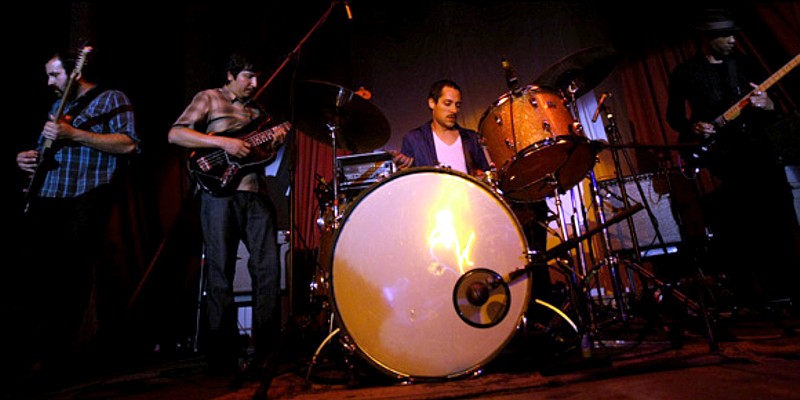
Greil Marcus said, "Everyone knows history moves in circles; the surprise is how big the circles are." But the reverse is true too, history is made of small circles and all those little circles make up bigger ones and so forth. Looking at Tristeza record covers one is struck by the reoccurrence of gyrational imagery. Circles spin out and away, interlink, break apart.Tristeza are in some sense about the gyre of time, ever widening and then narrowing, contracting. Eschewing those who would lump them into the amorphous category of post-rock, dubious of quiet-loud-quiet formulae, and circumspect towards musical individuality and the sense of One Big Song, the spirit they imbue a record with is the timeless love of musicians keeping time. By that I mean the world, its age, groaning and creaking underneath it.
As circles tighten, pop music tends to repeat itself unable to see beyond horizons of more than a decade in time, and this band, Tristeza... continues widening their cycles, past but not post, past a simple generational genre, part and parcel with music from around the world, from their homes and homelands in Tijuana, B.C., Oakland, CA or Michigan, from Afro funk and jazz, Spanish flamenco, tropicalia, Indian raga, to krautrock, and psyche to punk. From the record's start with its title "Ava", this is a thoughtful, spiritual flight. The time-space continuum crushed into itself and pulled out from itself, a shed snake skin.
Luís, Christopher, and Jimmy are Tristeza. They're all fathers now, getting wiser as they get older. "Castellón" reflects this with a graceful, yet shadowy noír tone combined with the band's classic circular sonic yearning suggesting some mystery at the beginning of a quest. Though separated geographically in their day-to-day, they make sure that when they're together the music locks in tight as ever, so there's a driving force here that seems downright celebratory.
This is vintage Tristeza staking ground like a classic pugilist; life and death in the nimble waltz of Mexican calaveras, the joy and the sadness, la tristeza, the impossibility of one without the other. Like the old maríachís, ni de allí, ni de acá, they are between worlds, and eternally fighting the good fight.
lunes, 28 de noviembre de 2011
History of composition
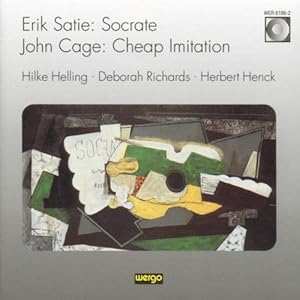
Like numerous other works by Cage, Cheap Imitation was a result of his collaboration with Merce Cunningham's dance company. However, in this case the original choreography relied not on Cage's music, but on a piano arrangement of Erik Satie's symphonic drama Socrate. In 1947 Cunningham made a dance based on the first movement of Satie's work, and Cage provided a two-piano transcription of the music (since Cunningham's dances were usually accompanied by means of piano only). In 1968 it was decided to expand the choreography by two movements, based on the remaining two of the Satie work. Cage, who was at the time working on HPSCHD, a large multimedia work, requested help of an acquaintance from the University of Illinois, Arthur Maddox, and together they completed a two-piano arrangement of the remaining two movements. The new choreography was to be premiered in early 1970.
However, in December 1969 Cage received news from Satie's publisher, Éditions Max Eschig, that he is refused the rights to perform the piece, even though Eschig haven't even requested to see the transcription. Because the choreography was based on the rhythms and structure of Socrate, Cage could not simply compose a new piece of music. He decided to imitate Satie's work in a piano solo. Cage titled the result Cheap Imitation, and Cunningham responded in kind, naming the choreography Second Hand.
Cheap Imitation became the last work Cage performed in public as a pianist: arthritis prevented him from doing any more performances. Nevertheless, even though his hands were painfully swollen, he still played it during the 1970s. Cage grew more and more fascinated with the piece, producing transcriptions for orchestra of a minimum of 24 performers and a maximum of 95 (1972) and for solo violin (1977) at the request of the violinist Paul Zukofsky (who in 1989–90 also assisted Cage in completing the Freeman Etudes, which had been started in 1977–80). The orchestral versions, however, were not performed until much later, because the musicians refused to rehearse and would subsequently discover the piece is too difficult for them.
Cheap Imitation became something of a departure for Cage, because it was his first "proper" composition, in the old sense of the word, since 1962. Furthermore, the open declaration of Cage's own feelings (about Satie's work) was something very unusual for his work, which was, since the late 1940s, almost entirely impersonal. Cage himself was well aware of the contradiction between the rest of his works and Cheap Imitation:
In the rest of my work, I'm in harmony with myself [...] But Cheap Imitation clearly takes me away from all that. So if my ideas sink into confusion, I owe that confusion to love. [...] Obviously, Cheap Imitation lies outside of what may seem necessary in my work in general, and that's disturbing. I’m the first to be disturbed by it.
Cage's fondness for the work resulted in a recording of him performing it, made in 1976—a rare occurrence, given Cage's negative attitude to recordings.
Cheap Imitation is a piece in three parts. It consists almost exclusively of a single melodic line, with occasional doublings. The rhythmic structure of the phrases is based on Satie's original, usually on the vocal line, occasionally on the orchestral parts. The pitches were determined using chance operations with the I Ching, through the following questions:
Which of the seven modes, if we take as modes the seven scales beginning on white notes and remaining on white notes, which of those am I using?
Which of the twelve possible chromatic transpositions am I using?
For this phrase for which this transposition of this mode will apply, which note am I using of the seven to imitate the note that Satie wrote?
Cage observed phrase and note repeats present in Satie's melodies, adding them to his imitation. The use of modes was unusual in that Cage used chromatic transpositions; the composer called Cheap Imitation a chromatic modal piece.
viernes, 11 de noviembre de 2011
1981 - John Cage Meet Sun Ra
For those who think Thom Yorke is weird, meet Sun Ra. Yes, this man calls himself Sun Ra. This isn’t a band name, this is a man. Although legally born Herman Poole Blount, Sun Ra took upon his persona after being nicknamed Sonny as a child. But his name isn’t even the weirdest part. The man claims to be of the “Angel Race” and from the planet Saturn. He’s so mysterious that people think his date of birth could be anywhere from 1910-1918. Sun Ra said his astrological sign was Gemini, but who knows if even he knows? Sun Ra, of course, was a musician. He performed free jazz, known for his piano and synthesizer skill. He sounds like no other piano or synthesizer player and makes Miles Davis’ experimentation look like Lawrence Welk swing. Critics call his technique “a variety of influences, including blues, Count Basie's bounce, Thelonious Monk's dissonance and a degree of European impressionism.”
John Cage isn’t exactly all that normal either. He has a bit more of a revered background, studying music at the Cornish School of the Arts. However, the formal studying never got to his head. He created some of the most unique and contemporary music of the 20th century. On top of creating a musical piece for twelve radio receivers and music for an ensemble of metal percussive instruments, Cage made countless pieces of music based on the theory of “chance music.” In the score, Cage wrote silence in his music, however, he knew that at a live performance no such silence would occur. The sound in the performance venue becomes the music. He even wrote his most famous piece based on this theory, 4’33”, a 4 minute 33 second song divided into 3 movements of written silence. Not a single note.
These facts about these two men are essential to understanding this live performance. Without this information, the 45 minute performance seems terribly odd and zany. Sun Ra’s spastic, heavy synthesizer matched with Cage’s minimalist, sparse vocal noises seem all too much for a stable, sane human mind. On this recording, there are literally minutes of absolutely no music going on at the time. Cage showcases his “chance music” theory on this live recording, and the crowd apparently knows his ideas well. However, the recording quality diminishes from the chance music theory. Either the crowd kept incredibly silent or the recording did not pick up the sounds coming from the crowd. Overall, the recording quality of the performance is quite poor, often sounding like an old 50s movie.
Due to variety and musicality, Sun Ra heavily defeats John Cage on the performance. He opens the concert with a huge, furious, dissonant keyboard performance. The crowd cheers wildly and the spacey synthesizer sounds jump all around the range of the instrument and jump around in styles just as quickly. Elements of jazz flow in and suddenly a huge, orchestral sounding chord will overpower the recording instrument. The synth voices change frequently from a typical square lead voice to a bell sound to a synthesized voice. Sun Ra uses his range of voices perfectly, creating a heavy, metallic sound at some points which makes an even more frenzied sound to the already insane harmonic structure. He manages to jump from the most beautiful chords to the most dissonance in a matter of seconds. His first appearance goes on for 7 and a half minutes, garnering tumultuous applause from the audience. He later closes out the first half of the performance with a much more eastern tinged movement. Just when his playing couldn’t get any darker, he spends most of the second half making ambient, creepy noises. Much in the manner of the Mars Volta, he goes off without any sense of time or rhythm, creating whatever comes to mind. However, he lets the ambience slowly build into huge, crashing chords of either beauty or dissonance. Everything is going somewhere.
John Cage is just the opposite. His performance is much simpler. He merely steps up to a microphone and makes strange vocal noises. Cage’s voice sounds akin to an aging Johnny Cash. However, Cage never steps over saying more than 3 or 4 syllables at a time. He takes minute breaks before starting another few indistinguishable syllables. Of course, he relies on his “chance music” theory to get away with the minutes of silence. Sure, it’s a profound and intriguing idea, but it just gets old after a few minutes, especially when the recording buzzes in the background due to the quality. In truth, Cage is reciting excerpts from one of his poems in some strange language, known as Empty Words IV. However, who knows what he is saying? Luckily, Sun Ra saves the performance on the second half by filling in where Cage leaves silence. He fills with light, dainty keyboard lines way up high on the keys. He lets Cage have the show, not doing much of anything, but neither Cage still does less than Sun Ra. Cage proves a better composer and philosopher than a performer. Regardless, the crowd eats everything up, probably being mostly young, profound college kids themselves.
Knowing the stories and ideas of these two men, the performance of this album is almost the sonic equivalent of their lives. Sun Ra shows off his zany, spaced out mind. His music sounds like it’s from another planet, a royal proclamation from Saturn. Conversely, John Cage shows his independent, introspective self with his Empty Words IV literature and extended periods of silence. The two together form a compilation of some of the strangest, weirdest, and somehow profound music of all time. Both men being underappreciated and extremely important 20th century innovators, they never worry about fans or appeal like so many other artists. The two men show a love for music, ideas, and the profound relationship between them.

John Cage isn’t exactly all that normal either. He has a bit more of a revered background, studying music at the Cornish School of the Arts. However, the formal studying never got to his head. He created some of the most unique and contemporary music of the 20th century. On top of creating a musical piece for twelve radio receivers and music for an ensemble of metal percussive instruments, Cage made countless pieces of music based on the theory of “chance music.” In the score, Cage wrote silence in his music, however, he knew that at a live performance no such silence would occur. The sound in the performance venue becomes the music. He even wrote his most famous piece based on this theory, 4’33”, a 4 minute 33 second song divided into 3 movements of written silence. Not a single note.
These facts about these two men are essential to understanding this live performance. Without this information, the 45 minute performance seems terribly odd and zany. Sun Ra’s spastic, heavy synthesizer matched with Cage’s minimalist, sparse vocal noises seem all too much for a stable, sane human mind. On this recording, there are literally minutes of absolutely no music going on at the time. Cage showcases his “chance music” theory on this live recording, and the crowd apparently knows his ideas well. However, the recording quality diminishes from the chance music theory. Either the crowd kept incredibly silent or the recording did not pick up the sounds coming from the crowd. Overall, the recording quality of the performance is quite poor, often sounding like an old 50s movie.
Due to variety and musicality, Sun Ra heavily defeats John Cage on the performance. He opens the concert with a huge, furious, dissonant keyboard performance. The crowd cheers wildly and the spacey synthesizer sounds jump all around the range of the instrument and jump around in styles just as quickly. Elements of jazz flow in and suddenly a huge, orchestral sounding chord will overpower the recording instrument. The synth voices change frequently from a typical square lead voice to a bell sound to a synthesized voice. Sun Ra uses his range of voices perfectly, creating a heavy, metallic sound at some points which makes an even more frenzied sound to the already insane harmonic structure. He manages to jump from the most beautiful chords to the most dissonance in a matter of seconds. His first appearance goes on for 7 and a half minutes, garnering tumultuous applause from the audience. He later closes out the first half of the performance with a much more eastern tinged movement. Just when his playing couldn’t get any darker, he spends most of the second half making ambient, creepy noises. Much in the manner of the Mars Volta, he goes off without any sense of time or rhythm, creating whatever comes to mind. However, he lets the ambience slowly build into huge, crashing chords of either beauty or dissonance. Everything is going somewhere.
John Cage is just the opposite. His performance is much simpler. He merely steps up to a microphone and makes strange vocal noises. Cage’s voice sounds akin to an aging Johnny Cash. However, Cage never steps over saying more than 3 or 4 syllables at a time. He takes minute breaks before starting another few indistinguishable syllables. Of course, he relies on his “chance music” theory to get away with the minutes of silence. Sure, it’s a profound and intriguing idea, but it just gets old after a few minutes, especially when the recording buzzes in the background due to the quality. In truth, Cage is reciting excerpts from one of his poems in some strange language, known as Empty Words IV. However, who knows what he is saying? Luckily, Sun Ra saves the performance on the second half by filling in where Cage leaves silence. He fills with light, dainty keyboard lines way up high on the keys. He lets Cage have the show, not doing much of anything, but neither Cage still does less than Sun Ra. Cage proves a better composer and philosopher than a performer. Regardless, the crowd eats everything up, probably being mostly young, profound college kids themselves.
Knowing the stories and ideas of these two men, the performance of this album is almost the sonic equivalent of their lives. Sun Ra shows off his zany, spaced out mind. His music sounds like it’s from another planet, a royal proclamation from Saturn. Conversely, John Cage shows his independent, introspective self with his Empty Words IV literature and extended periods of silence. The two together form a compilation of some of the strangest, weirdest, and somehow profound music of all time. Both men being underappreciated and extremely important 20th century innovators, they never worry about fans or appeal like so many other artists. The two men show a love for music, ideas, and the profound relationship between them.
jueves, 27 de octubre de 2011
Elvis Presley - Elvis: Rock, Sex, and Roll.


'Before Elvis, there was nothing'said John Lennon,'Hearing him (Elvis) for the first time was like busting out of jail,' stated Bob Dylan, you will have to understand the moral climate during the mid 50's to realize what a shook Elvis Presley was. On issue #1 of Revolver Mag, Dave Marsh published an article called 8 Revolutionary events that rocked the world, on the number one spot he places: Elvis Presley on TV (1956): 'Elvis on the Radio was radical enough, but putting him on the small screen was another matter altogether. It unveiled the predatorial leer and swarthy features that coded "Negro" to every bigot in America or the rest of the world. Broadcast into every living room, those hips wanted to fuck your daughter, your wife, and (maybe, even if you wouldn't admit it) you. MTV still hasn't come up with anything as creative, as sexy or, for that matter, as interesting.'
For the post war teenagers, Elvis meant rebellion, that sexy, breathlessly and frantic sound of his was the bad seed of defiance and disobedience that will rise during the mid 60's. 'When I first heard [Elvis Presley's] voice I just knew that I wasn't going to work for anybody; and nobody was going to be my boss.' summed up Dylan.' 'He taught white America to get down" said James Brown, as a racial integrator, Elvis took hold all over the South, Elvis -a working class Southerner- fused sounds of white country music with black blues and R&B. In an uptight white America segregation happpened in their very bodies, where sexuality needed to be separated from the rest of the cultural being, Elvis Presley came as a sexual awakening, the generally described 'frenezy' Elvis caused in the Audience was more like a sexual expression, a liberation from the taboos of the older generation, and that was the real fear regarding Elvis.
Here it is, Elvis: Rock, Sex and Roll, not a greatest hits collection, this is Elvis the rocker, malicious glee that 50 years latter still has that rebellious edge.
Diciembre: Nuevo album.
"Lonely Boy" is the first single off the forthcoming album El Camino - in stores Dec. 6th. Preorder the album today to get an instant download of Lonely Boy (where applicable) -
Official store - http://wbr.fm/TBKElCamino
iTunes - http://glnk.it/nl
Directed by Jesse Dylan
domingo, 16 de octubre de 2011
1993 - World Gone Wrong. Bob Dylan
En mayo de 1993, Dylan daría comienzo a unas sesiones de grabación en el garaje de su hogar de Malibú. Grabado en solitario en apenas unos días, un total de catorce canciones fueron registradas, de las cuales 10 fueron elegidas para éste su álbum número 29. Marcada por la distorsión, la calidad del sonido era bastante primitiva en comparación al estereotipo de música moderna de ese entonces, con apenas tres micrófonos situados aleatoriamente, la mezcla de las canciones se llevó a cabo en cassettes por el propio Dylan, insistiendo en que tales no habrían de modificarse posteriormente. De este modo Dylan buscaba desprenderse de su cualidad de superestrella que durante la década de los ochenta había mermado su creatividad e independencia artística, asunto que logró, al recibir esta pieza, una alarmante mala respuesta por parte de la crítica como de los viejos fans enamorados del Dylan rockstar de la década anterior. El álbum apenas llegó al número 70 en las listas de popularidad. Pero una nueva generación, la generación que por entonces escuchaba a Cobain cambiar la eléctrica por la acústica, descubrió y acogió a Dylan, y la tradición musical que él representa; de nueva vez, en un mundo de voces modificadas por computadora, estudios de sonido que semejaban un laboratorio de la NASA, y la sobreproducción de la música electrónica de entonces, el folk de Dylan volvía a sonar contracultural.

lunes, 10 de octubre de 2011
Un extraordinario compositor llamado Jon Brion
Músico del soundtrack para las películas Magnolia, Eternal Sunshine of the Spotless Mind y Synecdoque New York, entre otras. Productor de Largo, de Brad Mehldau, When the Pawn y Extraordinary Machine, de Fiona Apple, Friendly Fire, de Sean Lennon, Safe Trip Home, de Dido o Perfect Symmetry, de Keane. Como solista, compuso Meaningless.
miércoles, 21 de septiembre de 2011
miércoles, 31 de agosto de 2011

sábado, 13 de agosto de 2011
miércoles, 10 de agosto de 2011

Suscribirse a:
Entradas (Atom)
